We are a decade on from the passing of Canadian singer, musician, poet, and song-smith Leonard Cohen (1934-2016). Raised in the Jewish faith, and practising Buddhism in adulthood, Cohen’s music would spend many decades balancing tensions like the demands of faith and the need to ask questions. At times that music was ignored, or ridiculed for its seriousness.
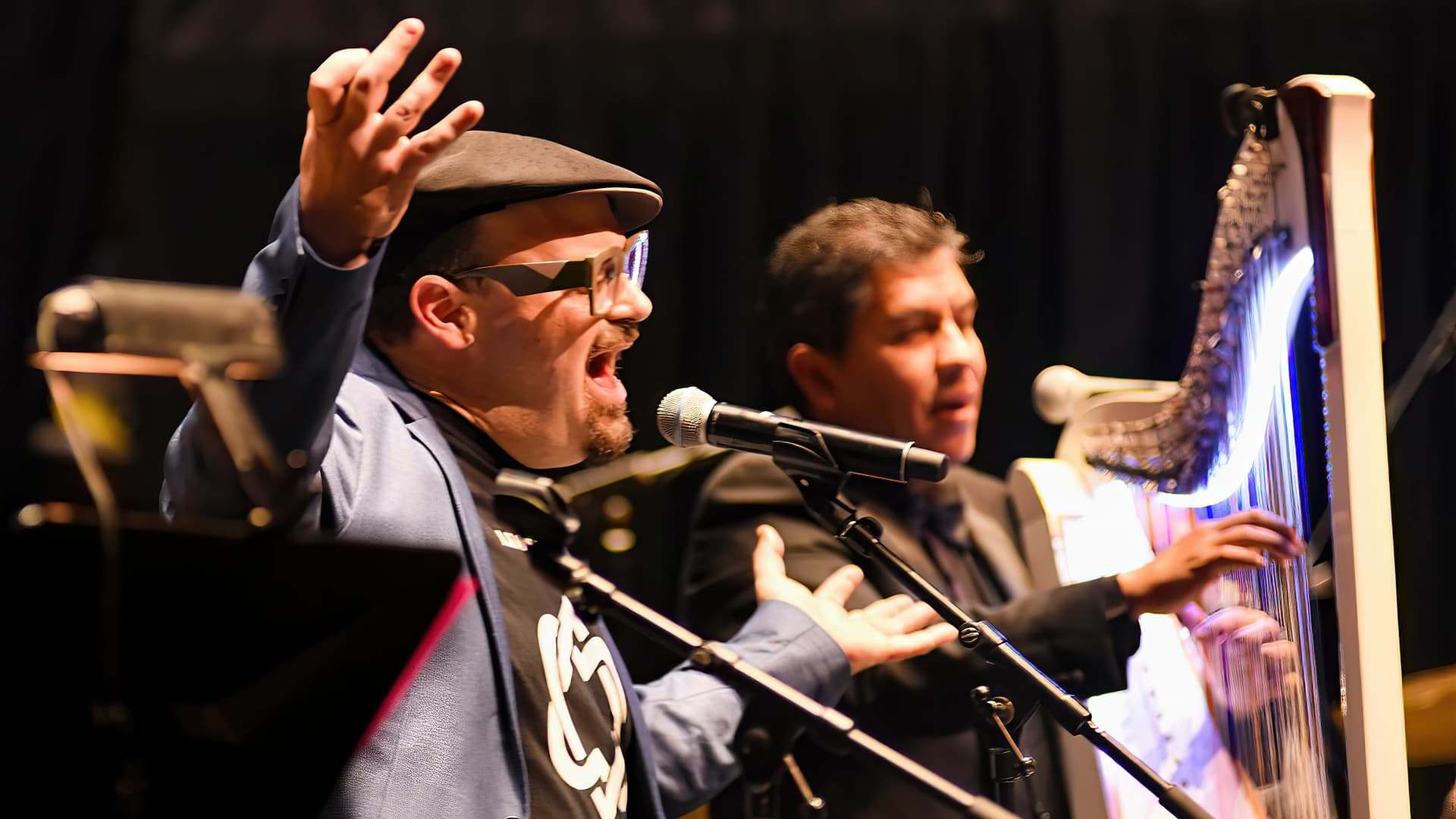
Cohen’s catalogue has inspired Australian group Monsieur Camembert to reinterpret some of his songs in their “gypsy and jazz” style. Based on the treatment here, calling the resulting show Cohen Noir seems somewhat inaccurate.
The show was framed as a specific kind of tribute, having the tagline of “The beauty, mystery, and romance of Leonard Cohen”. The master himself would feature in the show, with (as the festival programme advised) “rare” recordings of Cohen’s musings often used to introduce songs. Words from the musical director played a similar role, but the author of these was ambiguous. What was surprising, and later troubling, is that the darkness, melancholy, and yes “mystery” of Cohen’s lyrics were often stripped of their impact by the arrangements and vocal performances.
I was unfamiliar with Monsieur Camembert, but their inclusion in this festival suggested an understanding of cabaret’s role in challenging audiences. This is a festival which has brought us high-quality interpretations of the music of Bertolt Brecht and Kurt Weill, for example. However, Cohen Noir seemed to be pursuing a more easy-listening vision.
Those having some familiarity with Cohen’s music would know of his “tremolo” finger-picking guitar playing, associated with Flamenco music. (Notably, even Cohen’s early introduction to tremolo was entwined with tragedy.) This playing style could contribute to the sense of restlessness scattered through Cohen’s tunes. It was curious that this set seemed to steer away from such characteristics.
The show started with (and maintained) pleasant, technically proficient playing and singing, although it felt slightly curious for a well-known tune such as Famous Blue Raincoat (1971) to feel somewhat upbeat. Before too long, it would be perplexing to find that there wasn’t so much “noir”, despite the regular prompting of Cohen’s own introductory words.
To use the example of Hallelujah (1984), a song that took five years to write about (crudely, for brevity) a person trying to work out how to negotiate their place in the cosmos, Cohen wrote:
“ This world is full of conflicts and full of things that cannot be reconciled. But there are moments when we can reconcile and embrace the whole mess, and that’s what I mean by ‘Hallelujah.’ ”
Some artists have done a memorable job of communicating the sense of failure or acceptance of defeat implicit in Cohen’s offerings. As one mainstream example, recall how Shrek (2001) used John Cole’s take on Hallelujah. That was very different to decisions made in this show, where music and vocals would swell to a crescendo, recalling the audience manipulation of some Steven Spielberg blockbusters. Moreover, once recognised, the group’s approach to songs became obviously formulaic.
It seemed that Monsieur Camembert, supplemented by a local choir about halfway through, wanted us to have a lively time with glorious climaxes. That took priority over excavating the meaning under Cohen’s words, or having us sit with ambiguity. Feeling that this show was in danger of becoming uncomfortably superficial, I hoped that the act would at least spare one particular song by omitting it from the set.
A number of pleasantly performed songs followed, where guest vocalists sang well, just without kind of gravel or gravitas that someone like Mikelangelo has used to illuminate Cohen’s lyrics. It was a two-hour set, so there was certainly time for something to balance the cheeriness on display. Yet vocals, such as on Everybody Knows (1988) showed little trace of the ruefulness or tart shading we associate with Cohen’s output.
The pattern of the whole ensemble joining in for a song’s big finish largely continued. It all seemed a bit … neat and nice. Given how audiences often behave these days, it was notable that when a decent number of people surged to their feet to applaud a song, many remained seated. This suggested that not everyone was completely sold on the presentation.
The show’s concluding selection was (to my substantial concern given the last hour or so) Dance Me To the End of Love (1984). There was more exuberant playing of instruments, and all guest vocalists sang enthusiastically, some with ecstatic smiles on their faces. Inviting the audience into a singalong was the last, bitter straw. If you spent about 10 seconds on Google, you could find a discussion of how the song was inspired by a Jewish string group in a concentration camp that had to play music as other Jews were herded into gas chambers. Cohen fans were now forced to conclude that this show was content with a shallow engagement with his music.
The disservice to Cohen’s legacy is one thing, but it might also be a further symptom of a global trend. In recent times, journalists have noted the rise of Nazis around the world in this “age of forgetting”, as eye-witnesses die out, and younger people are ill-informed about WWII and the Holocaust. As a safeguard against such creeping ignorance, we look to artists to retain hard-won knowledge and prompt us to awareness. Whilst this show probably wasn’t intending to mishandle Cohen’s legacy, its hard to understand why it would take on his music but show little interest in how he used that in grappling with life’s complexities.
At the conclusion, Monsieur Camembert were fishing for an invite to a future festival, informing us that they also have a Louis Prima show. I know little about Prima, except for maybe the raucous I Wan'na Be Like You (The Monkey Song) from animated film The Jungle Book, and Pennies from Heaven in Elf (2003). Maybe that would be an extremely pleasant evening of swinging tunes with no pesky, gnarly depths to get in the way of the fun. How dispiriting it was that Leonard Cohen’s body of work should receive such treatment.
Event details
Adelaide Cabaret Festival
Cohen Noir
Monsieur Camembert
Director Name
Venue: Dunstan Playhouse, Adelaide Festival Centre SA
Dates: 20 June 2026
Bookings: cabaret.adelaidefestivalcentre.com.au